Is automating everything at once the best way?
A factory needs to increase its packaging capacity, but replacing the entire end-of-line requires investment, planning, and operational changes. Waiting until everything can be done might prolong a difficulty that already affects production.
Buying an isolated machine, without considering the rest of the process, can also create new limitations.
Between these two decisions, there is a possibility: automating in stages. To work, each investment needs to solve a current need and be planned together with what will come next.
The first investment needs a clear reason
Before choosing the equipment, it is necessary to identify what is limiting the operation. Is the product waiting to be packaged? Does movement require frequent interventions? Does the process depend on a team that the company has difficulty completing?
These situations can lead to different solutions. Therefore, the starting point is to observe the flow: how the product arrives, where it waits, which tasks require more time, and under what conditions it moves to the next stage.
Consider a hypothetical situation: packaging can meet demand, but the removal of volumes depends on manual movement and causes interruptions. Increasing the speed of the packaging machine, alone, might only make products accumulate faster at the exit.
In this case, movement deserves to be evaluated before an equipment change. The priority depends on the problem found in the factory.
One stage needs to communicate with the next
Automating in stages requires defining how each improvement will fit into the whole. This includes available space, equipment position, product characteristics, and the capacity of previous and subsequent operations.
If the intention is to integrate movement with packaging in the future, this possibility needs to be part of the discussion of the first project. Transfer heights, volume orientation, access for maintenance, and communication requirements between equipment are examples of points that engineering should evaluate.
Deciding these interfaces in advance helps reduce the risk of buying a solution that needs to be repositioned or modified in the next expansion.
It is also necessary to look at the routine during the transition. While part of the process remains manual, how will the transfer between stages be made? Who supplies and removes the products? How to preserve safe operating conditions? The intermediate phase needs to function by itself.
When staged implementation makes sense
This path deserves consideration when there is a well-identified limitation that can be addressed separately, maintaining the functioning of the rest of the line.
It can make sense, for example, when the factory needs to distribute investment over time, when demand grows gradually, or when there is existing equipment that still meets the operation and can integrate the solution.
Gradual implementation also allows monitoring the performance of each change before the next investment. For this, the company needs to record the initial situation and define what will be observed afterward: waiting time, effective production, frequency of interventions, or need for rework, according to the project's objective.
These records help verify if the first stage solved the foreseen problem and if the next priority remains the same.
When it is better to evaluate the whole from implementation
There are situations where the stages are so dependent that an isolated change delivers little result. A new line, a significant product change, or a capacity need involving several operations may require a more comprehensive implementation.
It is also necessary to consider the cost of successive interventions. Repeated layout changes, new installations, and adaptation periods can make project installment less attractive.
The comparison should include the initial investment and the consequences of each alternative: what will need to be modified, what limitations will remain, and how much additional work the next phases will require.
What to define before starting
A conversation about staged automation gains clarity when the factory gathers this information:
- Current problem: where the operation loses pace and under what conditions this happens.
- Products served: dimensions, weights, finishes, and relevant variations for the process.
- Demand: current volume and growth scenarios that need to be evaluated.
- Existing structure: equipment, space, facilities, and factory restrictions.
- Next steps: which operations can be integrated and what the first phase needs to foresee.
It is not necessary to have all the answers ready to start the conversation. The important thing is to involve those who know production, maintenance, and engineering, so that choices consider the real routine.
Starting with one stage, with the rest of the line in view
Projepack develops packaging, movement, and automation solutions for industrial end-of-line. When evaluating a staged implementation, these operations need to be considered together, even if investments happen at different times.
The best path depends on the problem, factory conditions, and the relationship between stages. A gradual project needs to deliver a useful improvement now and foresee how the operation can advance later.
Talk to the Projepack team about the operation you need to improve and your factory's expansion plans.
Projepack. Technology for industrial packaging.
Latest articles
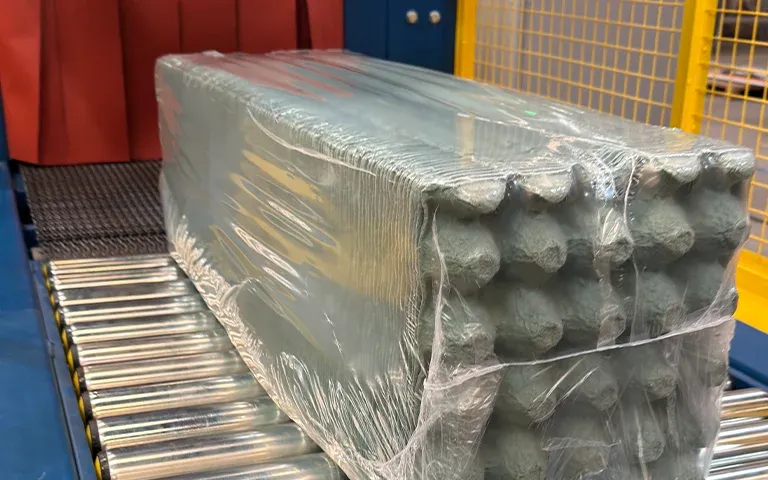
How to Reduce Damage and Protect Products During Industrial Transportation
Learn how packaging automation helps reduce product damage, improve load protection, and increase logistics efficiency in increasingly demanding industrial operations.

Why your shipping department needs to evolve
If you walk into your factory's shipping area today, what do you see? If the scene includes an employee circling a pallet, hunched over and holding a roll of stretch film, you have an invisible bottleneck draining your profits.
How to scale your production without compromising cash flow
In today's industrial landscape, agility is as vital as the technology itself. However, implementing a 100% automated line all at once does not always reflect the financial or operational reality of every factory. The good news is that modern engineering allows for a much smarter and more accessible path: modular automation.